Fifteen Plastic Packaging Statistics That Will Scare You

In a world where we are all trying to lessen the impact we have on the environment, one of the most significant influences that seem almost unavoidable is plastic. Going plastic is virtually impossible as it infiltrates so many aspects of life. From a plastic casing on a smartphone, to a plastic computer keyboard, to plastic bags, food wrap and bottles, it is hard for a day to go by without encountering plastic.

While plastics have been around for less than a century, they have dramatically changed the way we live. The benefit of plastic is it is incredibly hardwearing and designed to last for a very long time. However, this benefit has quickly become a problem for our ecosystem.

While some plastics can be recycled, a significant proportion ends up in landfill sites.

The plastic pollution can be dangerous for our health and the environment. Many plastics are toxic and can have an adverse effect on our health. Furthermore, with so much plastic waste in the oceans, it is affecting marine life, birds, the food chain and the ecosystem as a whole.

Due to the significant impacts that plastic has on the world, ecosystems and environment, it is essential to reduce our plastic use as much as possible. If you need further encouragement to limit your plastic waste, here are fifteen plastic packaging statistics that will scare you into thinking more about your plastic consumption.

15 scary plastic packaging statistics

1. One million plastic bottles are sold every minute

Drinks bottles are one of the most popular forms of plastic packaging which ends up as wastage. Frighteningly 20,000 plastic bottles are bought worldwide every single second. Sadly, less than 50% of these are recycled. Just 7% of the plastic bottles are transformed into new bottles.

When you consider that 480 billion bottles were sold in 2016 and less than 50% of these bottles were recycled, that means there were over 240 billion bottles that went into a landfill in a single year.

2. Yearly plastic waste can circle the earth four times

The amount of plastic packaging that is thrown away every single year is enough in length to circle the globe four times over. Furthermore the rate of plastic wastage is growing at a rate of 9% every year. Naturally, landfill does not help the problem, it just delays the problem for future years.

3. 12 billion tonnes of plastic waste in landfill by 2050

Since the beginning of plastic production, it is estimated that at least 8.3 billion tonnes of plastic have been produced. From this, at least 6.3 billion tonnes of plastic waste has been created and almost 80% have been put to landfill or is in the natural environment, such as the oceans.

With current production rates and continued mismanagement of plastic waste across the world, there will be 12 billion tonnes of wasted plastic in a landfill by 2050. With a single plastic bottle taking 450 years to biodegrade, does the earth have enough space for all of our plastic waste?

4. Plastic outnumbers sea life by six to one

There is more plastic in the oceans than wildlife. In fact, plastic outnumbers sea life by six pieces for every one animal. Furthermore 90% of the pollution floating in the ocean is plastic which accounts for 46,000 pieces of plastic in every single square mile.

5. 10 million tonnes of plastic end up in the sea every year

Ocean plastic is significantly impacting the environment and marine ecosystems. Plastic has entered the food chain with toxic plastic being found in birdlife as well as fish and sea mammals. From a study in the journal Science, they found that 192 coastal countries are adding to 10 million tonnes of plastic ending up in the sea each year.

There are five gyres in which plastic waste accumulates in the ocean, these gyres have a much higher concentration of plastic than anywhere else in the ocean due to the circular currents.

6. All sea turtle species have plastic in their bodies

Due to the tiny fragments of plastic in the ocean, all sea turtle species and 44% of seabird species have been found to have plastic in their system or around their bodies. This also includes 22% of cetaceans too.

7. There are 718 pieces of litter for every 100m of beach in the UK

In a single 100-metre stretch of coast in the UK, you can expect to find over 700 parts of plastic packaging waste. With research conducted by the Great British Beach Clean Up, you can expect to see 42 packets, 32 plastic caps or lids and 225 plastic bottles or polystyrene pieces, amongst many other parts of plastic pollution that are washed up by the sea.

8. 50% of plastic is used only once

Incredibly, half of the plastic that is destroying the ecosystem is created for single use. This could include plastic bottle, coffee cup lids and food packaging. With such a throwaway culture, only 5% of plastic is recovered from what is produced.

9. 7 million coffee cups are thrown away in the UK every day

Love a takeaway coffee? So, do 7 million other people in the UK. In just a single day, 7 million coffee cups are thrown away every single day. Many of these coffee cups are made from polystyrene complete with plastic lids.

With hardly any coffee cups or lids being recycled or recyclable, the harmless morning coffee may be significantly damaging the environment. Regularly enjoy a coffee? Why not invest in a reusable coffee cup, your coffee shop may discount your coffee because of it too.

10. One million plastic bags are used every minute

Forgetting your reusable bag at the supermarket is easy to do. In fact, one million plastic bags are used worldwide every single minute. This means that 500 billion plastic bags are used across the globe each year. By remembering a cotton bag or shops using paper bags could significantly lessen the damage of plastic on the environment.

11. 93% of Americans test positive for a plastic chemical

The chemicals of plastic not only affect the environment, but they also affect our health too. In fact in tests for BPA which is a plastic chemical, 93% of Americans over the age of six tested positive for traces of the chemical found in the body.

The absorption of plastic into the body can be damaging to health. While research is still ongoing it has been found that plastic compounds can alter hormones in humans.

12. The ocean has a plastic mass that is twice the size of Texas

Named the Great Pacific Garbage Patch, there is a floating plastic mass that is considered the largest ocean garbage site in the world. The mass is collated from the North Pacific Gyre which is a circular tide that brings pollution together into one big mass of garbage. So far, it has reached an enormous size and is already twice the size of Texas.

13. Only one-third of UK plastic packaging is recycled

Despite being more eco-aware, consumers in the UK still only recycle one-third of their plastic packaging. Two-thirds of plastic packaging is taken to landfill while a small proportion is incinerated. With this in mind less than half of the plastic goods that are recyclable are actually recycled. Much of this wastage comes down to a lack of recycling provisions and not being sure whether a product can be recovered or not.

14. One million seabirds are killed every year from plastic

As plastic enters the food chain and can cause damage to birds, such as birds getting stuck in plastic can holders has resulted in one million seabirds being killed every year from plastic in the ocean. Furthermore, 100,000 marine mammals are killed per year as a result of plastic in the water.

15. Not recycling costs the UK £78 million

Recycling plastic packaging can be an essential way to save money in the UK. By not recycling products it costs around £78 million a year for landfill costs. This money could certainly be better used by local authorities to provide other services. It can also save energy and new plastic production.

Ribble take recycling seriously

At Ribble we want to do all we can to make packaging sustainable and as eco-friendly as possible. We use recycled material to create our cardboard for packaging solutions, we also make sure that our cardboard packaging is fully recyclable too. If you want to find out more about the Ribble commitment to the environment, and how we can help your business with eco-friendly packaging, get in touch by calling 0161 622 2302.

Seven Reasons To Switch To Right Size Packaging

In many cases, packaging is as important as the product itself.

To customers, packaging says a lot about your business. In fact, from something as humble as packaging, your clients can understand aspects of your brand such as your commitment to protecting goods right through to your environmental credentials and eco-friendly stance. By choosing the right size packaging for your business, you can showcase your brand before a customer has even looked at what’s inside.

What is right size packaging?

It is very rare for a product to fit in conventional boxes for packaging exactly. Instead, businesses will use filler and padding to protect the product and give the product more security so that it fits more snugly in the box. However, by opting for customised options, you can have the right size packaging to ship your products without the need for extra packing materials.

With so many benefits of right size packaging, here are just seven reasons why you should make the switch to right size packaging.

Seven reasons to choose right size packaging

  • Reduce your packaging spend

The cost of packaging can quickly mount up and significantly reduce the potential profits from every sale. Using right size packaging means that you only have to use the amount you need. By reducing the amount of packaging or cardboard you use, you save money on your packaging materials. Your materials stretch further, meaning you can pack more products for the same cost as fewer products with standardised box sizes.

Not only does right size packaging mean you save money on your packaging orders, but you also reduce the administrative time of ordering materials too.

  • Reduce your carbon footprint

For most businesses, it is common to have a business objective or mission statement centred on sustainability and being more environmentally aware. Packaging is one area where you can show your commitment to reducing your carbon footprint and being more sustainable.

For example, your business can commit to only using recycled products for packaging material. At Ribble, all of our cardboard is recycled as well as being fully recyclable.  Furthermore, when you use right size boxes, you reduce the amount of cardboard and filling materials that you need. To help reduce wastage and lessen the impact on the environment.

  • Lower stock

If many different packaging products overrun your facility, then it may be time to switch to right size packaging. With right size packaging methods, such as Right Size, you have just one packaging material that is easy to store. This means your packing area can get rid of copious boxes and storage of a range of filler products that do not use the space efficiently.

The lower stock also helps to improve your on-demand supply chain, meaning you only have the necessary products available for your orders which can help to streamline your business and lower costs.

  • Improved protection

By using the right sized packaging for each product, you can ensure each item is snug and secure in its packaging. This means that throughout the potential turbulent shipping process, your product has the best possible protection.

Using the right packaging reduces the risk of damage to your products which will increase customer satisfaction on its arrival. In turn, this can reduce expensive returns and replacements for faulty products, all helping to improve your bottom line.

  • Better transportation

By having smaller boxes to fit products, you save on expensive empty space and reduce the cost of void fill. What’s more, it makes the process more efficient when transporting products as you can pack more onto a lorry or reduce the cost of shipping thanks to a lower weight and size.

Cutting the size and weight of each package, you can save on costs but also lower your carbon emissions to as you need fewer lorries to transport a greater selection of goods.

  • Increase customer satisfaction

Customers rely on packaging to protect their goods and make sure that they remain fully functioning after shipping. Firstly, by making sure your product arrives damage-free is the minimum expectation from a customer. Many consumers have a focus on the environment and will seek out brands who are committed to eco-friendly causes. By reducing the amount of packaging, you show consumers that you do not needlessly waste resources and damage the planet unnecessarily.

Furthermore, customers hate having to split and break down packaging to recycle and throw it away. Increased packaging increases their time processes as well as filling up the bin. Using right size packaging, you limit the excess and make the lives of your customers easier.

  • Save time = save money

By using an on-demand product to create your right size packaging for you, you can enjoy a quicker packing process. By producing one perfectly sized box to batch producing, Right Size can create the boxes you need, saving packers time and reducing the number of processes involved too.

By having a box making machine, you reduce the amount of work for packers, allowing them to be utilised in other aspects of the business, as well as reducing the pressure on busy staff.

Let your business reap the rewards of saving time, money and increasing productivity.

Supply Chain Examples: Six Businesses Getting It Right

For many businesses, one of the most complex processes to try and succeed with is supply chain management.

Supply chain management is an extensive concept covering all manner of business activities from product development right through to logistics. To help your organisation to improve its supply chain efficiency, it is essential to look to at the competition. By analysing what your competitors do, you can find techniques to take inspiration from and strategies that your business could also adopt.

By implementing a successful supply chain strategy, you not only lower costs across the whole business but also welcome the opportunity for growth and future investment. By adopting a failing supply chain, you may see your company facing debt and struggling to remain a competitive contender in the field.

Want to improve your supply chain capabilities?

These are six supply chain examples that show the efficiency and effectiveness of a supply chain when it is managed correctly.

Six effective supply chain examples

  • Amazon

For efficient supply chains, Amazon is the company that first comes to mind for many people.

Amazon is one of the largest internet-based retailers in the world, with the headquarters in Seattle Washington, Amazon also currently operates from thirty other country-specific sites. However, Amazon has a global reach thanks to Amazon Global Selling.

Amazon has an incredible supply chain which ships over 10 million different products, as well as operating a Marketplace system too. Their supply chain methods utilise the lowest levels of inventory possible yet with delivering with incredible speed. In some cases of Amazon Prime, deliveries can be with customers in under two hours.

With high levels of efficiency and a shopping experience that is entirely customer-driven, it is what many eCommerce businesses strive for. In the future, Amazon continues to strive for customer satisfaction by developing Prime Air, a drone delivery system to get packages to customers in just thirty minutes from ordering.

  • Coca-Cola

There are very few places in the world where Coca-Cola is not available.

Keeping every aspect in-house, The Coca-Cola Company product, market and distribute their products across the globe. Despite being a globally recognised brand, Coca-Cola is not just a broad distribution strategy. Each area of the market is segmented to enable Coca-Cola to focus their appeal and marketing. The flavours and concentrations of the drinks change, as do the size and presentation of products. In fact, 95% of beverages are made in the country they are sold to maximise efficiency.

Operating in over 200 countries, the logo is recognised by 94% of world’s population; Coca-Cola is an excellent example of how a supply chain does not just focus on logistics, it encompasses marketing, branding and advertising too.

supply chain, cardboard waste reduction

  • Zara

International clothing brand, Zara, is best known for its cutting-edge fashion but is less likely to be known as one of the best supply chain examples for its green credentials and commitment to waste management . Their waste management strategy encompasses many aspects of the supply chain helping to minimise the impact on the environment while being as efficient and cost-effective as possible.

In logistics, their vehicles use biodiesel while in production they focus on organic cotton and other environmentally friendly fabrics. The main commitment is through the production methods, where their innovative technology enables them to cut, measure and handle material as efficiently as possible to minimise wastage. By operating in 88 countries, their impressive environmental commitment for their supply chain is a testament to the brand and is perfect for the eco-conscious fashion buyer.

  • Unilever

Unilever is a consumer goods company that offers an extensive array of products. Despite producing a variety of products from food, cleaning agents, beauty and cosmetic items and beverages, it is impressive that one company can keep track of multiple supply chains in such an efficient manner.

By focusing a five-year strategy on restructuring their supply chain management and bringing in a range of supply chain specialists, Unilever managed to find $14 billion in cost-saving initiatives. With the increased use of technology throughout their supply chain, Unilever is a leader in consumer supply chain management.

  • Intel

Global technology manufacturing brand, Intel, is a business that focuses on market needs and demand supply. Using real-time analytics, Intel has become more competitive thanks to making instant decisions based on the real-time data. Using data for decision-making, Intel has managed to simplify their supply chains and use predictive analysis to manufacture on a ‘sense and respond’ basis.

Thanks to their innovative supply chain optimisation strategy, the return on investment within five years is $208 million.

  • Colgate-Palmolive

When Colgate and Palmolive joined forces, it was imperative that their supply chain underwent extreme changes in order to be effective. With this, Colgate-Palmolive had to move from regional to global in terms of manufacturing and distribution. By simply fixing inefficiencies, Colgate-Palmolive has already realised $4 billion in savings.

By investing in logistics, and removing silos, Colgate-Palmolive has created a supply chain strategy to impress.

Looking to improve your supply chain?

If you want to make efficiencies and savings to your supply chain, then Ribble can help. Ribble Right Size offers an innovative returns management solution that can help you to find value in returns by improving your reverse logistics process and allowing you to seek profits from reselling products at full value.

To find out more about improving your supply chain with Ribble Restore, call the team on  0161 284 9000.

The Box Manufacturing Process Explained

The humble cardboard box is one of the most used packaging materials. It is a core product in packaging manufacturing. It not only fills the shelves, but it can be seen all throughout the supply chain too. When looking at a cardboard box, typically printed and branded with inviting colours and wording, it is hard to imagine it started life as a tree. We discuss the box manufacturing process step by step.

As consumers, we often forget to consider how items came to be, but we think the packaging should be celebrated. So, how does a tree finally become a box?

The steps of box manufacturing

1.     The tree

While we ideally look for recycled cardboard for box production, at one point, a cardboard box started life as a tree. Typically, the trees used for box manufacturing are softwood trees such as pine and fir tree. The reason they are chosen is that they have long fibres which can help to create a smooth finish for the cardboard as well as creating tension which increases the strength.

Many manufacturers will choose wood from sustainable and managed woodland; this means that any trees that are felled are replaced to help maintain the ecosystem of the forest. The paper and cardboard created will have a different colouring depending on the tree used. For example, silver birch trees will produce a dark colour, while a spruce will create a light brown colour.

2.     The pulp

From felling the tree, wood chips are made. These wood chips are then broken down into pulp. This can be done through grinding the wood against a stone or chemically cooking the wood chips. With this, you can add chemicals such as sodium sulphate to increase the strength of the pulp. For most cardboard, the pulp is left as the same colour. However, it can also be bleached to create a white appearance.

3.     Corrugation

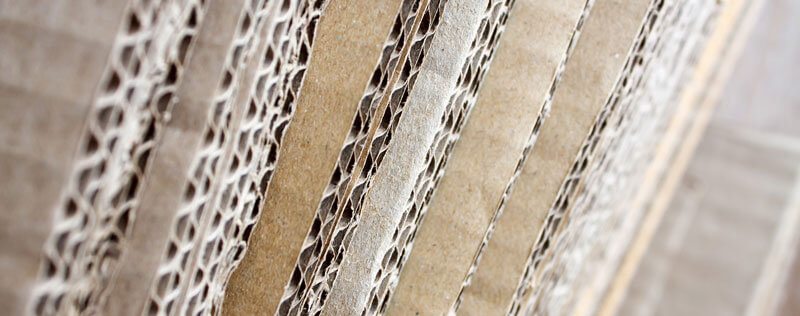
Once the pulp has been dried, you can then start to create cardboard. For corrugated cardboard, it requires two pieces of paper or card called liners and a portion of fluted cardboard, which sits in between the liners. To fluting helps to give the cardboard further strength and a higher level of protection against damage.

Rolls of the paper made from the dried pulp are fed through a corrugated roller, which flutes or ruffles the paper. Depending on the quality of the box being made will depend on the level of fluting required. As increasing the fluting leads to higher use of material and therefore increased strength, this is used for high-quality boxes. For cheaper boxes, less fluting can be used which can help to create space-saving, a reduced amount of material used and can lower the carbon emissions.

The corrugation machine uses hot steam to create the flutes. At the same time glue is rolled down each side of the flute, so that is sticks to the liners. Once corrugated cardboard is formed, it is then trimmed to provide straight edges.

4.     Cutting

Now that you have complete corrugated cardboard, it is time to cut the card to size, depending on the box requirements. There is a comprehensive guide, and many of the machines are programmed to cut the cardboard to scale automatically depending on production demand. Once the basic outline has been cut, the card is then sent to a trimmer.

The trimmer is designed to deal with intricate aspects that the cutting machine cannot handle. A trimmer can add handles to boxes and cut flaps that are needed to construct the box. The trimmer also scores the cardboard, making it easier to fold when the box is ready for assembly.

5.     Assembly

Assembly will depend on the requirements of the box. The use of flaps and slots may be best for business who want to construct their boxes on demand. As well as these, boxes built with tape are often efficient to be constructed as and when they are required. Usually, for more robust boxes, glue and stitching are used to fold sections together and keep the box secure.

Specific innovative machinery can construct boxes for you on demand. For example, Ribble Right Size is an on-demand box making machine. It creates the perfect size box depending on your needs to reduce waste and ensure the best fit. The box is constructed for you which can significantly reduce packing production time.

After assembly, offcuts can be recycled to continue in the chain of box making. After the boxes have been branded, printed and utilised, they can be recycled and create a continuous cycle of recycled box manufacturing.


Why Is Cardboard The Best Packaging Material?

Is cardboard the best packaging material? Its popularity is evident but why?

For businesses of any size, you need to be sure that your products are well-protected. Not only do you need to make sure that items have great packaging to prevent damage, but there are also a wealth of other considerations to think about. Aspects of packaging that you may consider could include its environmentally-friendly credentials, aesthetic qualities, practicality and ease of transportation.

Here we look at some of the many reasons that cardboard consistently comes through as an excellent material for packaging

Five reasons why cardboard is the best packaging material

1.     Versatility

Cardboard can be creatively adapted to suit a range of products in varying shapes and sizes. Utilising advanced designs, cardboard packaging can have multi-uses or create forms never thought possible.

In some cases, brands have created their cardboard packaging to offer a further use after packaging. This extends the life of the product and shows the brand’s commitment to less waste. For example, clothes brands can use cardboard packaging which can be transformed into clothes hangers, giving consumers a further use out of their packaging.

With its versatility, you have to option to package many products using the same material. For example, Ribble offer on-demand box making technology, Right Size, so you can have the right box for your product and save on wastage.

2.     Ideal branding

While plain cardboard can be an effective packaging design in itself, cardboard can easily be transformed through colour, shape and branding. Cardboard is easy to print on or embossed to create genuinely personal packaging.

Using colours and logos, cardboard can quickly be transformed from dull packaging into vibrant and exciting protection that makes your brand easy to identify. Consider cardboard as a blank canvas, upon which you can convert with your wording and imagery to make your products fly off the shelves.

3.     Recyclable

Another considerable advantage of cardboard packaging is the fact that it is recyclable. For consumers, this brings many benefits as it is easy to dispose of and does not need special treatment to get rid of it. Most councils will pick up cardboard through their recycling collection programme, while there are many places to recycle cardboard across the UK.

What’s more, cardboard can be made of recycled material too. At Ribble, all of our boxes are made from 100% fully recycled material as well as being recyclable at the end of life also.

4.     Cut transportation costs (and the carbon footprint)

As cardboard is lightweight, it makes means the packaging does not add too much to the weight of the product overall. With lighter packaging, it makes products easier to transport and more cost-effective as you save on fuel when you save on weight. By saving on fuel, your transportation costs can be significantly reduced. Not only do you see cost-savings, but you can also reduce your carbon footprint by using less fuel.

In terms of transportation, cardboard is also very durable making it the best packaging material for business. It helps to prevent moisture from infiltrating the product; this is an essential factor for products that need to withstand long transportation times, as well as protecting food products.

5.     Cost-effective

Compared to many other packaging products, cardboard is an extremely viable option for businesses of any size. Cardboard is considered particularly cheap compared to more expensive packaging solutions such as plastic. If assessing solutions such as corrugated cardboard, then these are highly affordable as they require less material than normal cardboard, yet still give robust protection and are lightweight too.

By ordering cardboard in bulk, you can often save considerably on your packaging costs. Also, as cardboard packaging is usually delivered flatpack, you can order in bulk but still have the room to store it, so it is there when you need it, but does not take up an excessive amount of space.

Choosing cardboard for your packaging solution

If you are trying to find the perfect material for your packaging needs, then speak to the experts at Ribble. Ribble offers a wealth of cardboard packaging solutions that are recyclable and versatile. From standard boxes to bespoke packing systems, Ribble can help to ensure you have an innovative packaging solution that meets all your needs. What’s more, Ribble work with all manner of businesses, offering competitive solutions for small and large companies.

Find out more by getting in touch.

Reduce Your Environment Impact With Responsible Packaging

For every business, responsible packaging should be a goal and a priority. Consumers are now not only looking for quality packaging that suitably protects their products but is also eco-conscious too. For marketers, logistics and finance departments, choosing the right packaging must appeal to all departments internally as well satisfying customers too.

Packaging is an often overlooked by commercial businesses however it is a valuable branding tool. It not only ensures your product is attractively displayed and safely secured, but it also explains your brand message to the consumer; this means you can showcase your environmentally friendly credentials with eco-friendly packaging.

What is responsible packaging?

Responsive packaging is mainly aimed at saving the planet and being environmentally friendly; this could be from reuse and recycling to being made from recycled products or eco-friendly products. However, the responsible packaging does not just have to focus on its green credentials; it can also be innovative and social too.

Packaging designs should appeal, whether it is from its eco-friendly materials, its stylish or useful design or the secondary uses for customers after it has fulfilled its primary job of protecting products.

Ultimately, the primary aim of responsible packaging is to lower your carbon footprint.

Follow the three critical areas;

  1. Reduce

  2. Reuse

  3. Recycle.

With this, you not only reduce your environmental impact, but it can also help to save on cost too.

How to adopt responsible packaging

  1. Determine your key packaging requirements

Before you can find the right sustainable packaging that will lessen your environmental impact, you must first establish what makes good packaging for you and your needs. Packaging can have many uses and benefits, from extending shelf life to protecting fragile items to making transportation more manageable, to be able to post the product easily.

Before determining the most environmentally friendly packaging, you need to know what your goals for the packaging are.

  1. Reduce

The first way to lessen the environmental impact of your packaging is by looking at unnecessary packaging within the process. Does any part of the packaging not fulfil a purpose?

If any aspect of the packaging does not meet a requirement, whether it is protecting the product, increasing shelf life or providing the customer with information, then it may be worthwhile removing this step in the packaging process.

Consider the value each part of the packaging has, if it appears to have none, it is wasting money from your business. Once you have removed irrelevant elements, it is time to consider how else you can reduce the packaging. Typically, this will be through the size and shape of the packaging. By making it lighter and smaller, you can significantly reduce the energy costs during transportation.

  1. Reuse

Reuse can span many different areas in terms of packaging. You can reuse within your from the packaging given by your suppliers or from packaging returns if you have a reverse logistics system set up to receive packaging items once the customer has received the product.

Reuse can also occur after your product has been shipped by the potential reuse of your packaging for your customers. More and more businesses are becoming increasingly inventive with their reuse methods, changing from recyclable bags to creating seed pots for compostable planting. Some food packaging is now edible, so there is no wastage from the packaging.

  1. Recycle

One of the fundamental areas of environmentally friendly packaging is its recyclability. Customers are now more environmentally aware and will look for methods to be green, particularly when it comes to product packaging.

When choosing packaging products, businesses should now focus on whether it can be recycled and if so the measures people will need to go to in order to recycle. Packaging may have to be labelled as to which parts are recyclable and which are not, and to show your eco-friendly mission, should be relatively easy to recycle to encourage all of your consumers to go green.

Go green with Ribble

As an environmentally friendly packaging company – Ribble can help to lessen your environmental impact with 100% recycled packaging products which can then be recycled by your customers. Our continuous recycling cycle is a great way to reduce the damage to the environment and showcase your business as one that cares about their carbon footprint.

Not only do Ribble just use recycled cardboard for their recyclable packaging but they can help you to reduce your packaging amounts too. Right Size creates boxes to suit the exact shape and size of your product. This means there is less packaging waste, lower energy costs in transportation and a smaller amount of packaging to be used.

Top 9 Environmental Packaging Products Saving The Planet

Nowadays, a good product is no longer enough to satisfy the ever-demanding consumer. Customers are much more aware of the whole package, and many have an eco-friendly conscience. With this in mind, more and more commercial businesses are looking at ways they can include their green credentials into their products. One of the best ways to showcase environmental responsibility and awareness is through innovative environmental packaging.

Throughout the retail world, organisations are looking at the best eco-friendly packaging products to suit their needs. Here are nine of the best eco-friendly packaging products that your business should consider.

What is environmental packaging?

Environmental packaging is designed to be eco-conscious. It uses products and materials that can be easily recycled and is safe for both the environment and people. Ideally, green packaging will use both renewable and recycled material.

Nine top environmental packaging products

  1. Popcorn

Popcorn is the ideal packaging for protecting fragile items. It protects products in a comparable way to foam nuggets or polystyrene chips. However, it is much lighter, saving energy during transport. Also, popcorn is entirely biodegradable, customers can simply put the popcorn into their compost bins, and it will degrade and become compost for their plants next year.

With popcorn, you can include another environmentally friendly packaging product, such as recycled cardboard for a full solution that completely eliminates the need for harmful, plastic packaging.

  1. Bamboo

Bamboo grows particularly fast and has strong fibrous properties making it the ideal green material for packaging. Naturally, bamboo can have a use in a range of products from socks to baby wipes. However, the waste bamboo that can’t be transformed into a product can be turned into a pulp which can then be moulded into the packaging.

Bamboo packaging is wholly natural and requires no toxins in its production making it safe to produce and throw away after use. What’s more, bamboo packaging has been shown to be ideal for food packaging as it is safe to be used in microwaves, ovens and freezers. Even better, throughout this, it still maintains its strength and durability and can be used again and again.

  1. Biodegradable carrier bags

Using flax fibres from industrial waste can be used to create non-woven carrier bags that naturally biodegrade after a specified period of time. Not only do these bags utilise waste products but they also do not require expensive recycling processes or need to be added to ever-growing landfills.

These bags are ideal for retailers who want their customers to join with the eco-friendly revolution. The can also help to differentiate their business away from typical retailers who use wasteful and damaging thick plastic bags. Biodegradable flax bags are a great way of being noticed for your ethical principles.

  1. Sea plastic

Incredibly, we can save the planet with packaging. Companies are now retrieving the plastic waste from the oceans to create brand new packaging. The plastic that is collected from the sea can then be combined with durable sugar cane for strength to help make strong new packaging.

Not only does this packaging help to reduce the amount of plastic being produced, but it also is an excellent incentive for fishers and those at sea to capture the plastic and clean up our oceans o help protect the wildlife and keep the waters clean.

  1. Biodegradable custom moulds

Fragile products often require excessive packaging to help to keep them in position during transportation. Usually, this packaging is costly due to its custom design and uses a high quantity of packaging material to keep it safe.

Now you can find customised moulded packaging that is completely natural and biobased which, with the addition of a natural thickening agent, grows around your product to cradle it into position carefully. These custom moulds can then be reused or your customers can add the packaging to the compost bin as it is entirely biodegradable.

  1. Air

Air is a lightweight, protective packaging that can be used for all manner of products. Inflatable air packaging can be used for electronics, pharmaceutical products and even glass bottles. Air cushioning fully protects products with its shock absorbing characteristics as well as being customised for the right shape and size.

Air packaging is also lightweight, cutting down energy costs required for transport. What’s more, air packaging needs less space than other packaging methods so you can cut your transport costs too.

  1. Disappearing envpackaging

There is a growing trend for eco-friendly packaging material that creates no wastage and is utterly convenient for consumers as it completely vanishes. You can now find environmentally friendly packaging that produces absolutely no waste and doesn’t even require any recycling.

Packaging products are made from tree pulp, and bioproducts such as starch and corn can then be manufactured so that they disintegrate in water. The non-toxic residue can be safely washed down the drain which is entirely harmless in water. Many products can utilise dissolvable packaging from the food industry to electronics.

  1. No-packaging packaging

For every retailer, where possible, they should be looking to eliminate packaging altogether. For many products, it is surprisingly easy to get rid of packaging. For example, food outlets can ask customers to bring in their own reusable containers and rolls of bin bags can be stored in the last bag of the pack. Grocery companies are also waking up to the fact that packaging is no longer required.

Zero-waste packaging may soon be the thing of the future. Many products may have an original packaging element to them, which just needs creative tweaking to keep it safe from damage and present it as a quality product.

  1. Recycled cardboard environmental packaging

For bulk packaging and items of all shapes and sizes, cardboard may still be the answer. However, cardboard can still be environmentally friendly, providing you choose cardboard from sustainable sources. At Ribble Packaging, all of our cardboard packaging solutions are made from 100% recycled packaging, which is then encouraged to be recycled again.

Despite being recycled, the cardboard is still versatile and durable which makes it ideal for a range of packaging solutions. Ribble Packaging provides all manner of recycled cardboard solutions from bespoke designs to on-demand corrugated card machinery.

By utilising recycled products, we can convert the recycled goods into new packaging and save the planet every single day as the cycle continues.

Green Packaging Solutions: What Is Fanfold?

For businesses looking for cost-effective and green packaging solutions, then fanfold should be a serious consideration. Fanfold is effectively a long sheet of corrugated cardboard that can be used to protect and package a variety of products. The fanfold aspect comes into play as the long piece of corrugated cardboard is scored at regular intervals so that it can be folded neatly and compactly, like a fan.

Fanfold packaging seems simple enough, but it comes with many benefits for your business.

Fanfold, a green packaging solution:

Firstly, the fanfold packaging is a green solution for your business. Every business should focus on reducing waste, for their own cost-efficiency as well as helping to lessen the impact on the environment. If you’re looking for an eco-conscious solution for your packaging needed, then fanfold, coupled with a Box on Demand machine, is an excellent way for your company to go green.

Other benefits of fanfold packaging

  • Reduce your packaging inventory

Why have multiple packaging products when you can have one?  Regardless of your products and their various shapes and sizes, just using a Box on Demand system with fanfold corrugated cardboard can suit a range of packaging requirements and reduce your packaging stock to only one product thanks to its flexibility and versatility.

Green benefit: by swapping your packaging to fanfold only, you can stop using harmful plastic packaging and switch to an entirely recyclable packaging option.

  • Safe transit

Corrugated cardboard offers an excellent level of protection for goods while they are in transit. By using fanfold packaging, you have a supply of cardboard that you can score to size to ensure every product is well protected. With fanfold packaging, you reduce the need for extra filling materials, therefore saving on cost, but you still provide an exceptional level of protection. What’s more, fanfold packaging can be customised for your bespoke needs.

Green benefit: having customised packaging ensures you receive maximum efficiency, reducing the waste your business creates.

  • Simplified administration

With only one product for your packaging needs, you instantly simplify the administration process for your packaging department. Fanfold packaging means you have just one product to stock take and only one product to order. If you choose bespoke fanfold packaging, you also streamline the whole packaging process, making it much quicker to parcel goods and get them into transit.

Green benefit: Using customised fanfold green packaging solutions means each product is packaged to suit its size. By using tailored packaging, you reduce wasted space meaning you can fit more items in transit through space utilisation, reducing the transportation needs and lessening the effects on the environment.

Discover the uses of green packaging solutions

With tailored widths, shapes and scoring, fanfold packaging can be utilised for a range of different packaging needs when used with the right equipment. As well as this, it can be an excellent surface for high-quality print to ensure your high-quality packaging is printed to allow your brand to shine. The practicality of fanfold packaging meets its green credentials with a wide variety of scoring options as well as being able to score on site your own needs.

Ultimately, fanfold packaging ensures a high-quality product, cost-efficient packaging with green benefits that give your business an eco-friendly boost.

Seven Benefits of A Packaging Automation Process

One of the biggest causes for concern in business is the rising costs and the best approaches you can take to help combat increasing expenditure and make savings where possible. Fortunately, there are ways to keep your business sustainable and ensure a healthy bottom line, one of these is through automation, particularly in the packaging sector with packaging automation processes.

An important consideration for businesses is how to ensure a packaging process provides a respectable return on investment. So often, the cost of staff leads to non-value-added processes that are wasting both time and money. What companies need to do is find ways to be greener, more sustainable, reduces costs and eliminate wastage. One of the best ways to do this is through automated packaging machinery and automating packaging processes.

What is packaging automation?

Packaging automation uses packaging machinery at various stages of the packaging process such as filling and sealing boxes, wrapping and labelling machines and coding and strapping products. Machinery can be both automatic and semi-automatic, covering a range of tasks but, as the name suggests, semi-automatic packaging machinery will require more labour.

Depending on the return on investment you can receive will play a part on the type of automated packaging machinery that will provide the most benefits and least costs to your business.

Seven benefits of packaging automation

  •  Productivity

Typically, automated packaging machinery will process goods much faster than the manual methods. Depending on the type of automation and the number of products you need to package, a machine will be able to wrap hundreds of items a minute, for example into blister packs. With packaging machinery, you can dramatically increase productivity to save time and ensure a faster production line.

  • Safer working conditions

If the items that you are packaging are bulky, cumbersome and heavy, then there can be a risk for health and safety. If your business employs personnel to package products that are heavy, then you have the chance of injury and costly time off work as well as the cost involved with ensuring rigorous health and safety compliance. Automated packaging takes away this problematic issue and creates a safer working environment.

  • Meticulous quality

With automated packaging, you can be sure that every package is well-protected through a standardised packing process. With automated packaging, each product has a tailored packaging design and shape so that you can be sure of the same level of protection for each item, and there is a routine use of stock.

  • Saving the planet with reduced wastage

One environmental benefit of packaging automation is that a packaging machine will only use a set amount of material and will be economical in its use of material, cutting to size and creating an efficient pattern that maximises protection out of the minimum level of material. This method can also save your business a considerable amount in packaging costs by reducing the amount of waste and streamlining the types of packaging you need to prevent over-ordering of various materials.

  • Specialised packaging

Whatever your product is, you can find an automated solution that is tailored to your item. Whether is vacuum packing, pressure filling, sterilised or inflatable, you can find the right piece of equipment to suit your bespoke needs. If you package many different products, then an on-demand solution that tailors each package to suit the shape of the product is ideal.

  • Lower costs

Labour intensive processes can be expensive but also fluctuating, making it hard to calculate the budget required for your packaging sector and the cost of packaging per product. Fortunately, automated packaging solutions are standardised, typically with a fixed price for the machinery as a set amount of packaging per product that can be calculated easily. By reducing the labour requirements, you can find a use for staff in value-adding areas elsewhere in the business.

  • Efficiency

Automated packaging can serve as a double benefit, covering the role that is too repetitive and straining for staff to undertake happily and also take on the tasks that are too difficult for a human to do. Whether it’s a large item, monotonous smaller jobs that are the same day in, day out or a job for multiple people, then automation may be the best way to combat these problems and have an efficient process. Rather than struggling with employing staff or worker retention, you have a reliable packaging machine that can take on the work and isn’t afraid of a repetitive task.


If you would like to speak to one of the Ribble team about our environmental standards or find out how packaging automation could help your business, get in touch.

Is Plastic Packaging Destroying Our Environment?

Plastic, a material that has now caused worldwide controversy after a global spread of pollution across our oceans; all thanks to its poor bio-degradable properties, human misuse and overall promotion of irresponsible environmental initiatives. Plastic packaging is causing issues for the environment.

Plastics that contain virgin resins, are a cheap alternative produced from petroleum or natural gas into small pellets known as ‘nodules’. The manufacture of these pellets alone is contributing to the depletion of natural resources, consuming 4% of the world’s oil supply. Although, it should be identified that plastic materials can be energy efficient, as it takes less energy during its manufacture then its rival glass material, including low transportation costs due to being lightweight and results in 40% less fuel for transportation.

Is there a more sustainable solution to plastic packaging?

It is without doubt plastics are a ‘wonder material’ they are adaptable and durable for most products, which has accelerated their production, but is there a more sustainable solution?

Over the last 65 years or so scientists have predicted 8.3 billion tonnes have been produced, with approximately 70% of this production present in our current waste streams – mostly sent to landfill.

Half of this material has been made within the last 13 years and current trends point to 12 billion tonnes of plastic waste by 2050. Waste deposited in landfill can reach harmful chemical levels, that spread into groundwater resources and contribute to contamination of the natural environment. When plastic products enter a water source whole, it can float around almost forever and endanger marine life.

It has been identified that most commonly used plastics are not biodegradable, providing few alternatives for disposal, following a decomposition process known as either pyrolysis or incineration through a thermal recovery facility. Although, the latter is further complicated by health and air quality concerns. Many animal studies suggest a developing link between exposure to chemicals and negative health outcomes, with findings of ‘micro-plastics’ in the bodies of marine life which demonstrates the reality of our environment.

Packaging is a short-use product that has poor recycling statistics, with only an estimated 9% of disregarded plastic being disposed of environmentally.

With raw material prices increasing, it is becoming more financially viable to recycle polymers. Including investment into innovative engineering and biological initiatives to create a more sustainable solution.

What is the solution to improving plastic packaging?

One solution is to treat plastic as a reusable material rather than a disposable commodity that can be carelessly discarded. Efforts towards increasing recycling facilities for this material and providing treatment to ensure it is suitable for its next process. Creating a sustainable culture through knowledge is highly advantageous and would increase recycling efforts for all our materials to ensure we reducing pollution rates.

Copyright © Ribble Packaging Ltd.
Designed by Definition Consulting